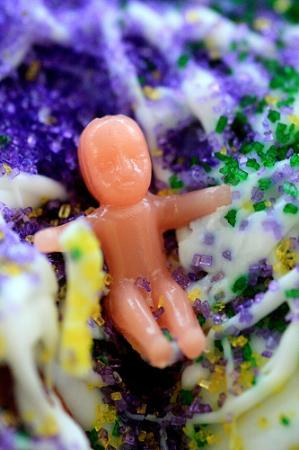
Showing posts with label baby cake. Show all posts

Wednesday, December 22, 2021

More on Baby Cakes, later called Twelfth Night Cakes (this time with Beans and Peas)


Robert Herrick from the frontispiece of Hesperides 

Today’s focus is the food in the festive poetry of Robert Herrick, who was, as mentioned yesterday, a follower of Ben Jonson and supporter in writ of Royalist hospitality in the seventeenth century. He went to Cambridge, took orders and was a Church of England vicar for much of his adult life. This position was taken from him by the Puritan-leaning Parliament in 1647, after Royal defeats early in the English Civil War. It was restored to him again by Charles II in 1662. Looking for income in the intervening years he published his poetry under the title Hesperides, or, The Works Both Humane & Divine of Robert Herrick, Esq. in 1648. 

The first bit of Herrick’s holiday food we will look at is one found in the Jonson Masque; it requires a slight correction and further explanation. A Baby Cake was one name for little pastry figures representing the Christ Child. However, with further research, the Baby Cake mentioned by the earlier writer was actually more like the King Cake I compared to those. 

The character Babie Cacke in the royalty-presented Christmas, His Masque is accompanied by an usher who bears a great cake. One detail I failed to go into was the fact the cake came with “a beane and a pease.” This is what it most sounds like, the cake had a bean and a pea (both probably of the harder varieties) within it. 

We can use Herrick to explain what Jonson is referring to. Here is a poem from Hesperides, entitled “Twelfe night, or King and Queene:” 

Now, now the mirth comes 

With the cake full of plums, 

Where Beane's the King of the sport here; 

Beside we must know, 

The Pea also 

Must reveal, as Queene, in the Court here. 


Begin then to choose, 

(This night as ye use) 

Who shall for the present delight here, 

Be a King by the lot, 

And who shall not 

Be Twelfth-day Queene for the night here. 


Which known, let us make 

Joy-sops with the cake; 

And let not a man then be seen here, 

Who unurged will not drink 

To the base from the brink 

A health to the King and the Queene here. 


Next crown the bowl full 

With gentle lambs-wool; 

Adde sugar, nutmeg and ginger, 

With store of ale too; 

And thus ye must doe 

To make the wassail a swinger. 


Give then to the King 

And Queene wassailing; 

And though with ale ye be whet here; 

Yet part ye from hence, 

As free from offence, 

As when ye innocent met here. 

The occasion is the Twelfth Night or Epiphany Eve (5 January) and there is a cake full of plums (probably actually raisins – more on that soon). The bean and a pea hold special places, they will reveal the King and Queen. It is like the still-current practice of King Cake, where a figure of a baby is baked into the cake and whoever gets the piece that holds it is declared king. In this case, the piece with the bean would “cho[o]se” who would “Be a King by the lot,” ie. lottery, while the piece with the pea “must reveal” the queen. I find an interesting parallel with the Princess and the Pea from Hans Christian Andersen but since that comes from a Scandanavian tradition, the connection would need be very far back, maybe before the English split from those peoples.  

In another of his poems, A New Years Gift, Herrick speaks again of this celebratory quasi-ceremony. His gift is a verse that will speak of the joys the season just passed, he writes: 

Of twelfth-tide cakes, of pease and beans, 

Wherewith ye make those merry scenes, 

Whenas ye chuse your king and queen, 

And cry out, Hey for our town green! 

This tradition was, even then, an old and wide spread one. The later seventeenth century writer Aphra Behn, in her short story, “The Court of the King of Bantam” has characters gather on “the Evening o' Twelfth-day, to renew the famous and ancient Solemnity of Chusing King and Queen.” A passage detailing the night reads: “After Supper...then the mighty Cake, Teeming with the Fate of this Extraordinary Personage was brought in, which was then Cut and Consulted, and the Royal Bean and Pea fell to those to whom Sir Philip had design'd 'em.” Finding a bean in a cake was apparently part of an old saying then; one translator of John Calvin has him say in 1587, “they thought themselves to have found wisdom, like as we commonly say in the Proverb, that a man thinks he hath found the Bean in the Cake.” Calvin was French and the porcelain or now plastic baby in King Cake, or Galette des Rois, in the older French tradition, was once a fava bean. 

A British political carton by Isaac Cruikshank from 1797, showing a later version of a Baby Cake called a Twelfth Night Cake. 

There was more than just cake in Herrick’s “Twelfe Night”, including drinkable Lamb’s Wool, and culinary hospitality makes a number of appearances in his other works. More on those markers of Christmas cheer tomorrow.


Tuesday, December 21, 2021

Minced Pie and Baby Cake but Foh! to Fish and Fasts: Christmas Presented to the King in 1616.

Today we will have a slightly more modest portion of hospitality from the seventeenth century, covering a bit of what Robert May pined for, before the period of “unhappy and cruel Disturbances” that was the English Civil War. The focus will be the food.

We can turn to a relatively well-known poet/dramatist to see Christmas food in the first half of the seventeenth century. Ben Jonson was second only to Shakespeare in his influence on the stage during the reign of James I at the beginning of 1600s. He wrote a masque simply called Christmas, His Show or Christmas, His Masque. This form of drama is a kind of Early Modern musical – there was a story enacted, but also music and dance with often expensive and elaborate sets. Usually, they were performed in a noble house and included praise and/or a message for the wealthy host.

Jonson’s holiday extravaganza was presented at the royal court in 1616. Some of the festive food elements in Christmas, His Masque are actually characters. The play begins with Christmas personified bursting onto stage; he is soon followed by an entourage of his children. One is our old friend MINC'D-PIE, who appears “like a fine Cook’s Wife, dressed neat; her man carrying a pie, dish, and spoons.”

Christmas’s other child of culinary interest is BABIE-CACKE “dressed like a Boy, in a fine long coat, biggin [a cap like a nightcap], bib, muckender [handkerchief], and a little dagger; his usher bearing a great Cake.”

A Baby Cake is a holiday food that has been lost amongst the English world’s traditions but it is probably related to the porcelain or now plastic baby figures that are still found in celebration King (or Three King) Cakes, like those eaten at festivities in New Orleans. The King Cake is, and the Baby Cake was, served up especially at the Epiphany, twelve days after Christmas, celebrating Christ’s revelation to the three magi or kings. The baby, of course, represents the Christ Child and it was once popular for bakers to give such a small image made of pastry to each of their customers at Christmas. John Brand, a writer on "popular antiquities" or folklore in the eighteenth century says they were also called Yule Dough or Dow or Yule Cakes in the north of England. Writing even in 1777, he believed the practice “is now, if I mistake not, pretty generally laid aside, or at most retained only by children.”

A modern plastic baby in a King Cake.

In Jonson’s Masque, the two personified Christmas treats take part with the other children of Christmas in singing a welcome to the King and Queen, a future king and other nobles: 

“Now God preserve, as you well doe deserve, 

your Majesties all, two there; 

Your Highnesse small, with my good Lords all, 

and Ladies, how doe you do there? 

Gi'me leave to aske, for I bring you a Masque 

from little little little little London; 

Which say the KING likes, I ha'passed the Pikes, 

if not, old Christmas is undone.” 

The welcome ends with a bit of vague warning about the holiday being undone, this is soon explained as having a Christmas food context. Christmas picks up on it and asks: “whats the matter there?” One of the other children - Gambol, who represented Christmas dancing or frolicking answered: “Here's one, o' Friday street would come in.” This is a reference to fish or fast Fridays and the child of Christmas is warning that the belief that the hol(y)days should be practiced as more somber, less food-filled occasions was starting to come into English society.


The Father sounds angry: “By no meanes, nor out of neither of the Fishstreets, admit not a man; they are not Christmas creatures: Fish, and fasting dayes, foh!” The Puritan ideals that conflicted with many Church of England traditions and came to a head in the English Civil War, were beginning to gain a significant following even when this masque was performed in 1616. Those views were especially prevalent in London, which the song of Christmas’ children mentions. Among the things in the Masque that were probably offensive to those of such faith was the Christ being an image - in the form of a cake - and that He was a child of and subject to Christmas, the festival.

In opposition to Puritan sentiments, Father Christmas sings of what his children will present to the King and his court: 

“Now their intent, is above to present

with all the appurtenances

A right Christmas, as of old it was,

to be gathered out of the Dances.”

Appurtenances are additional elements, in modern culinary speak he could have said “with all the trimmings.” Their presentation, their holidays included everything. This is the “right” Christmas, as it used to be. There are, of course many other elements to festive celebrations but as the representation of Minced Pie and Baby Cake as children of Father Christmas shows, lots of food was vital to the hospitality of the holiday.

A later representation of Christmas and His Children by Robert Seymour (1836). Baby and King Cake may be conflated and seen in back left with a possible Minced Pie beside him. An interesting addition is the central Sir Loin. 

Tomorrow we will look at the Christmas poetry of Robert Herrick.  He was one of the Sons of Ben, followers of Jonson who supported James’s son Charles I with their writings.