Today we will have a slightly more modest portion of hospitality from the seventeenth century, covering a bit of what Robert May pined for, before the period of “unhappy and cruel Disturbances” that was the English Civil War. The focus will be the food.
We can turn to a relatively well-known poet/dramatist to see Christmas food in the first half of the seventeenth century. Ben Jonson was second only to Shakespeare in his influence on the stage during the reign of James I at the beginning of 1600s. He wrote a masque simply called Christmas, His Show or Christmas, His Masque. This form of drama is a kind of Early Modern musical – there was a story enacted, but also music and dance with often expensive and elaborate sets. Usually, they were performed in a noble house and included praise and/or a message for the wealthy host.

Jonson’s holiday extravaganza was presented at the royal court in 1616. Some of the festive food elements in Christmas, His Masque are actually characters. The play begins with Christmas personified bursting onto stage; he is soon followed by an entourage of his children. One is our old friend MINC'D-PIE, who appears “like a fine Cook’s Wife, dressed neat; her man carrying a pie, dish, and spoons.”

Christmas’s other child of culinary interest is BABIE-CACKE “dressed like a Boy, in a fine long coat, biggin [a cap like a nightcap], bib, muckender [handkerchief], and a little dagger; his usher bearing a great Cake.”

A Baby Cake is a holiday food that has been lost amongst the English world’s traditions but it is probably related to the porcelain or now plastic baby figures that are still found in celebration King (or Three King) Cakes, like those eaten at festivities in New Orleans. The King Cake is, and the Baby Cake was, served up especially at the Epiphany, twelve days after Christmas, celebrating Christ’s revelation to the three magi or kings. The baby, of course, represents the Christ Child and it was once popular for bakers to give such a small image made of pastry to each of their customers at Christmas. John Brand, a writer on "popular antiquities" or folklore in the eighteenth century says they were also called Yule Dough or Dow or Yule Cakes in the north of England. Writing even in 1777, he believed the practice “is now, if I mistake not, pretty generally laid aside, or at most retained only by children.”
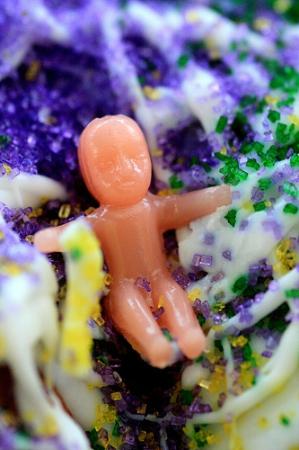 |
| A modern plastic baby in a King Cake. |
In Jonson’s Masque, the two personified Christmas treats take part with the other children of Christmas in singing a welcome to the King and Queen, a future king and other nobles:

“Now God preserve, as you well doe deserve,
your Majesties all, two there;
Your Highnesse small, with my good Lords all,
and Ladies, how doe you do there?
Gi'me leave to aske, for I bring you a Masque
from little little little little London;
Which say the KING likes, I ha'passed the Pikes,
if not, old Christmas is undone.”

In opposition to Puritan sentiments, Father Christmas sings of what his children will present to the King and his court:

“Now their intent, is above to present
with all the appurtenances
A right Christmas, as of old it was,
to be gathered out of the Dances.”
Appurtenances are additional elements, in modern culinary speak he could have said “with all the trimmings.” Their presentation, their holidays included everything. This is the “right” Christmas, as it used to be. There are, of course many other elements to festive celebrations but as the representation of Minced Pie and Baby Cake as children of Father Christmas shows, lots of food was vital to the hospitality of the holiday.
 |
| A later representation of Christmas and His Children by Robert Seymour (1836). Baby and King Cake may be conflated and seen in back left with a possible Minced Pie beside him. An interesting addition is the central Sir Loin. |
Tomorrow we will look at the Christmas poetry of Robert Herrick. He was one of the Sons of Ben, followers of Jonson who supported James’s son Charles I with their writings.

No comments:
Post a Comment