Showing posts with label Robert Herrick. Show all posts

Friday, December 24, 2021

Come Bring the Noise: Poetry for Christmas Eating and Service


We continue today with Robert Herrick and some simple messages of holiday food and hospitality.  It being Christmas Eve, I present a few more bits of festive and welcoming poetry, to wish you the best of the season. 

From “Ceremonies for Christmasse” in Hesperides, this time beating Public Enemy to the punch, Herrick writes of more mince pies and plums in pastry: 

Come bring the noise,

My merry, merry boys, 

The Christmas log to the firing;

While my good dame, she   

Bids ye all be free,   

And drink to your heart's desiring.   

... 

Drink now the strong beer,   

Cut the white loaf here,   

The while the meat is a shredding   

For the rare mince-pie   

And the plums standing by,   

To fill the paste that's a kneeding. 


Another about pie, this time probably a  one large like the Yorkshire Christmas Pie I wrote about earlier.  Herrick calls it a ceremony, so maybe this speaks of a solemn duty; it is certainly a different ritual than leaving milk and cookies for Santa.    

From: "Christmasse-Eve, Another Ceremonie." 

Come, guard this night the Christmas pie,   

That the thief, though ne'er so sly,   

With his flesh-hooks don't come nigh   

To catch it.   


Finally, verses written in praise of fulfilling a duty: to share whatever bounty you have with your fellows.  When you are enjoying your Christmas meals, you must also think of others.  

From "A Panegerick to Sir Lewis Pemberton."

To the worn Threshold, Porch, Hall, Parlour, Kitchin, 

The fat-fed smoking Temple, which in 

The wholesome savour of thy mighty Chines 

Invites to supper him who dines, 

Where laden spits, warped with large Ribs of Beef, 

Not represent, but give relief 

To the lank-Stranger, and the sour Swain; 

Where both may feed, and come again. 

… 

But from thy warm-love-hatching gates each may 

Take friendly morsels, and there stay. 


Let us share what we can this Christmas, be it food or knowledge or whatever.   

Thursday, December 23, 2021

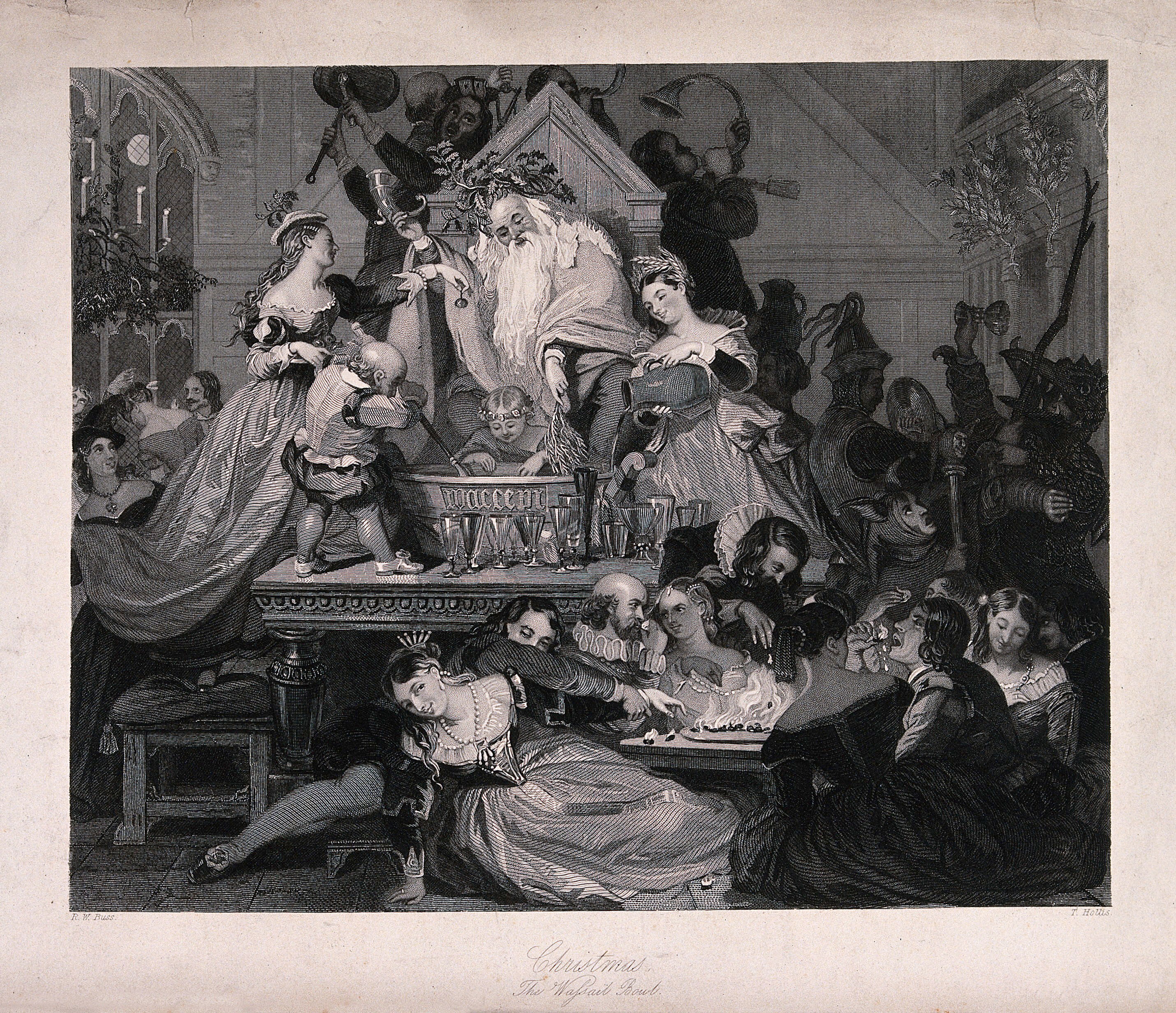
Make Your Wassail a Swinger: Carouse with Lambs-wool to Your Guests' Health.

A later engraving of Father Christmas at the wassail bowl. 
By T. Hollis from the early 19th century.
Photographed by the Wellcome Collection.

We will continue looking at edible and quaffable elements in Robert Herrick’s holiday poems, leading into the fundamental moral and political ideal of hospitality. Returning to his “Twelfe night, or King and Queene,” we find that after the plum-filled cake is used to make known the king and queen for the evening, it is used to dip in, or is soused with, drink. Herrick writes:


“Which known, let us make

Joy-sops with the cake,”


“Joy-sops" is just a more poetic way of saying the poetic phrase “sops of joy.” What the cake is being sopped in is interesting. The ultimate goal is “To make the wassail a swinger;” what precedes this are, in other words, instructions to make a great drink.


But let us see those directions or a basic recipe again:

Next crown the bowl full

With gentle lambs-wool;

Add sugar, nutmeg and ginger,

With store of ale too.

And thus ye must do...


The initial royal flourish aside, the only thing a bit different is “lambs-wool.” This is not as strange as it seems; it is a drink, still known some places today, and a period synonym for wassail, in fact. There was a later seventeenth century book called The Academy of Armory, part of which functioned as a kind of dictionary for scienctific pursuits and what we would call today, the trades. 


In the section, “The Names of Several Dish-Meats and Cooks Terms Alphabetically,” between “Umble Pie, is a Pie made of the Intrals of a Deer, as Heart, Liver, &c.” and “Whipt Cream, it is beaten thick with a Whisk, then eaten with Cream and Sugar” is the definition of interest:

“Wassell, is a drink of Ale, toasted Apples, Sugar and Cinnamon mixt. Of some called Lambs-Wool.”

This even more basic recipe has a few minor differences but there are some shared, basic ingredients – sugar, apples and ale.

Why was it called lambswool? (What wassail means we will get to later as well). Some writers think that the fuzzy head on it reminded the drinkers of the small animal’s covering. General Charles Vallancey, a British army surveyor sent to Ireland disagreed. He stayed in Ireland after his service and became a writer on Irish history and customs. In Volume III of his Collectanea de Rebus Hibernicis [Collection of Irish Affairs], published in 1786, he says:


“The first day of November was dedicated to the angel presiding over fruits, seeds, & c. and was therefore named LA MAS UBHAL, that is, the day of the apple fruit, and being pronounced LAMASOOL, the English have corrupted the name to LAMBSWOOL, a name they give to a composition made on this eve, of roasted apples, sugar and ale.”

So, we know from many sources how to make a swinging wassail. Interesting that Robert Herrick was using “swinging” as a positive adjective well before the 60s or even Jazz Age.

The poet recounts the use of this drink in celebration elsewhere in his collection Hesperides. In verses talking about the good old days with a friend, he says they should relive various celebratory times. One instance being:


Then next I’ll cause my hopeful Lad

(If a wild Apple can be had)

To crown the Hearth,

(Lar thus conspiring with our mirth)

Then to infuse

Our browner Ale into the cruse:

Which sweetly spiced, we'll first carouse

Unto the Genius of the house.


A “lar” is a Roman household god or spirit; in the English context it was a fairy-like being which was often a guardian of the hearth and therefore good conspirators in this context. Once the lambswool or wassail is put together, essentially what is a toast is made to the lar: the speaker and his guests “first carouse / Unto the Genius of the house.” When it first came into English from Latin, “genius” meant an attendant household spirit. 

That act also points to another word meaning: any “wassail” is a toast in and of itself. The Middle English predecessor to the word was the phrase wæs hæil - “be in good health.” This in turn came from the Old Norse ves heill with a similar meaning. The proper response to wæs hæil, if you are wondering, is drinkhail - “drink good health.” Important to remember.

While there are still many cocktail recipes online for lambswool, I will be trying a basic kid-friendly one over the next couple days and will report back. Also, tomorrow will be more about Herrick, both food and our more serious obligations for holiday hospitality.


Wednesday, December 22, 2021

More on Baby Cakes, later called Twelfth Night Cakes (this time with Beans and Peas)


Robert Herrick from the frontispiece of Hesperides 

Today’s focus is the food in the festive poetry of Robert Herrick, who was, as mentioned yesterday, a follower of Ben Jonson and supporter in writ of Royalist hospitality in the seventeenth century. He went to Cambridge, took orders and was a Church of England vicar for much of his adult life. This position was taken from him by the Puritan-leaning Parliament in 1647, after Royal defeats early in the English Civil War. It was restored to him again by Charles II in 1662. Looking for income in the intervening years he published his poetry under the title Hesperides, or, The Works Both Humane & Divine of Robert Herrick, Esq. in 1648. 

The first bit of Herrick’s holiday food we will look at is one found in the Jonson Masque; it requires a slight correction and further explanation. A Baby Cake was one name for little pastry figures representing the Christ Child. However, with further research, the Baby Cake mentioned by the earlier writer was actually more like the King Cake I compared to those. 

The character Babie Cacke in the royalty-presented Christmas, His Masque is accompanied by an usher who bears a great cake. One detail I failed to go into was the fact the cake came with “a beane and a pease.” This is what it most sounds like, the cake had a bean and a pea (both probably of the harder varieties) within it. 

We can use Herrick to explain what Jonson is referring to. Here is a poem from Hesperides, entitled “Twelfe night, or King and Queene:” 

Now, now the mirth comes 

With the cake full of plums, 

Where Beane's the King of the sport here; 

Beside we must know, 

The Pea also 

Must reveal, as Queene, in the Court here. 


Begin then to choose, 

(This night as ye use) 

Who shall for the present delight here, 

Be a King by the lot, 

And who shall not 

Be Twelfth-day Queene for the night here. 


Which known, let us make 

Joy-sops with the cake; 

And let not a man then be seen here, 

Who unurged will not drink 

To the base from the brink 

A health to the King and the Queene here. 


Next crown the bowl full 

With gentle lambs-wool; 

Adde sugar, nutmeg and ginger, 

With store of ale too; 

And thus ye must doe 

To make the wassail a swinger. 


Give then to the King 

And Queene wassailing; 

And though with ale ye be whet here; 

Yet part ye from hence, 

As free from offence, 

As when ye innocent met here. 

The occasion is the Twelfth Night or Epiphany Eve (5 January) and there is a cake full of plums (probably actually raisins – more on that soon). The bean and a pea hold special places, they will reveal the King and Queen. It is like the still-current practice of King Cake, where a figure of a baby is baked into the cake and whoever gets the piece that holds it is declared king. In this case, the piece with the bean would “cho[o]se” who would “Be a King by the lot,” ie. lottery, while the piece with the pea “must reveal” the queen. I find an interesting parallel with the Princess and the Pea from Hans Christian Andersen but since that comes from a Scandanavian tradition, the connection would need be very far back, maybe before the English split from those peoples.  

In another of his poems, A New Years Gift, Herrick speaks again of this celebratory quasi-ceremony. His gift is a verse that will speak of the joys the season just passed, he writes: 

Of twelfth-tide cakes, of pease and beans, 

Wherewith ye make those merry scenes, 

Whenas ye chuse your king and queen, 

And cry out, Hey for our town green! 

This tradition was, even then, an old and wide spread one. The later seventeenth century writer Aphra Behn, in her short story, “The Court of the King of Bantam” has characters gather on “the Evening o' Twelfth-day, to renew the famous and ancient Solemnity of Chusing King and Queen.” A passage detailing the night reads: “After Supper...then the mighty Cake, Teeming with the Fate of this Extraordinary Personage was brought in, which was then Cut and Consulted, and the Royal Bean and Pea fell to those to whom Sir Philip had design'd 'em.” Finding a bean in a cake was apparently part of an old saying then; one translator of John Calvin has him say in 1587, “they thought themselves to have found wisdom, like as we commonly say in the Proverb, that a man thinks he hath found the Bean in the Cake.” Calvin was French and the porcelain or now plastic baby in King Cake, or Galette des Rois, in the older French tradition, was once a fava bean. 

A British political carton by Isaac Cruikshank from 1797, showing a later version of a Baby Cake called a Twelfth Night Cake. 

There was more than just cake in Herrick’s “Twelfe Night”, including drinkable Lamb’s Wool, and culinary hospitality makes a number of appearances in his other works. More on those markers of Christmas cheer tomorrow.