Friday, December 31, 2021

Wassail, Battalia Pie and Marrow Pudding: Your Menu for New Year's

 In an effort to present some food for New Year’s Eve, it becomes a bit difficult to separate the elements of cheer into specific days in the festive period. Traditional things eaten and drunk before Christmas were often consumed through New Year’s (sort of, more on that) to the Twelfth Night and Day. We shall see that when we look at a bill of fare for the traditional New Year’s Day.

My above parenthetical caveat comes from the fact that until 1752, the technical and civil New Year was 25 March (Lady’s Day) in England. The Scots were well ahead (or going retro) and changed the celebration to 1 January in 1600. However, this did not prevent there being celebrations on that day during the festive period and, as we shall see, cooks from acknowledging 1 January as a feast day called the New Year.

Returning to the search for things enjoyed on the evening, one - wassail – seems especially important in the celebrations on 31 December. We talked a fair bit about wassail in terms of both Christmas and Twelfth Night but a little more explanation and a maybe dodgy period origin of the term seems in order.


In a book originally from 1656 with the snappy title: Glossographia, or, A dictionary interpreting all such hard words of whatsoever language now used in our refined English tongue comes an entry on “Wassail or Wassale.” Dictionaries weren’t what they are today, there is not much of a definition, though what is there is useful for us: “on Twelf-day at night, or on New-years Eve.” The drink and its role were so well known, the author did not feel he needed to include more, apparently.

However, he does provide an “Origin” by quoting a story from the Anglo-Dutch translator and historian Richard Verstegen who wrote about thirty or forty years earlier:


Lady Rowena and Hengistus or Hengist were semi-legendary figures amongst the Anglo-Saxons that invaded Briton, while King Vortiger or Vortigern, was a military leader, possibly king, of the peoples who were invaded. To summarize, Rowena having been invited to dinner, presented her British host a cup of wine with the phrase Wae Heal Halford Cyning – "Be of good health, Lord King." He did not understand but got a translator to give him the correct response Drink Heal – "Drink health."

The origin is similar to what we have heard before but this time it comes from a legendary royal source. Thomas Blount, the author of Glossographia adds after: “I have also heard another (but less handsome) etymology of this word...because common people do often, wash their throats with Ale, the old Saxon liquor.” As he says, less handsome and almost certainly not true. Whether the drink’s name has roots in British and Anglo-Saxon royalty it is certainly buried deep in the history of the island where they clashed and in its New Year’s celebrations.

Having drunk our wassail – a basic recipe for one type of it is here – we can finish tonight’s thoughts with a bill of fare or menu for New Year’s Day. This comes from the same cook, Robert May, that presented a bill of fare for Christmas that we picked over a bit.


A photo from I took in Wellcome Library in London of 
a later edition of the Accomplist Cook.


Our mince pies are here again and I have explained before a little about many of the dishes and ingredients above. Some I have not included: snites or snipes are a water bird; Battalia pie and Orangado pie are dishes I would like to do at a later date but here are short explanations.

Orangado from the Orangado pie is a preserved or candied Seville orange, suckets from the Tart Royale are similar preserved sweetmeats.

Battalia (or Battaglia) pie’s name comes from the French béatilles which in turn is a diminutive of the Latin beatus. Bible readers will know the beatitudes ie. “Blessed are the...” The French word then means “little blessed things.” In the pie the little blessed things were offal, or the rest of lots of different animals. Robert May’s recipe, for instance, includes lamb-stones, veal sweetbreads, twenty cock's combs and cocks-stones as well as the main meats and artichoke, oysters, pistachios and hard-boiled egg yolks.

That one being a pretty interesting sourcing experience, I turn to one more menu item I can explain a bit - the "Marrow Pudding bak't."  But that explanation will wait until tomorrow as I have some bone marrow and plan to make it a part of my New Year’s bill of fare. Look in for that experience.

Thursday, December 30, 2021

"This kils, not cures charity.": Christmas Fights Against His Rejection

An engraving from the 1653 pamphlet The Vindication
of Christmas
, possibly by also by John Taylor. Christmas 
in the centre is menaced by one and welcomed by another.

A couple days ago, in The Complaint of Christmas, we left the far-travelled titular character just as he arrived in England. John Taylor, the (English) author, has him do a joyful little dance because he has arrived in the “ancient Harbour or heaven of happiness, in the Eden of the Earth, the Paradise of Terrestrial Peace, Plenty and Pleasure, the most fruitful Garden of the rotundious Globe, the comfortable Canaan, that flowest with Milk and Honey.” The holiday personified exclaims: “Thou (O England) hast ever given old Christmas (with his twelve Holy-day Servingmen) good entertainment, with such cheer, hospitality, and welcome, as the Christian world never hath done the like." 

However, things are not as of old and therein lies the real Complaint. English hospitality, even in 1631, is a pale ghost of its former self. Christmas goes to a manor where he has been welcomed in many years past but all he finds there is an “old poor half-starv'd Servingman” bemoaning the present state of the house, “watering every word with a tear.” He greets the potential guest with: 

“Oh Christmas, old reverend Christmas! whither art thou going? What haste art thou now making to this house, where hospitality had once her habitation; where the poor man was relieved, the stranger succored, the traveler refresh'd, and all men bid welcome?" He explains: "This house that from the Conquest hath been famous for Hospitality, is now buried in her own ruins.” 

The culprit is the young master, who is off in the City of London and partaking of all that represents in commercial interests. As I mentioned in an earlier post, it is not new to condemn monetary forces that overwelm other aspects of the festive season. The seventeenth century serving man that Christmas meets gives a number of examples in which foodstuffs (the backbone of the holiday) have been decimated for new concerns.

“Is there a Calf or Sheep in the Pastures? no, they are all knockt on the head, and have their throats cut, having Parchment made of their skin to make him bonds after he had sold their flesh. Look into the Garden, is there a Beehive there? no, all the honey-birds are fled, and the Wax spent in sealing Bonds for Commodities. Look about the Yard, there is not a Ducke, Chicken, Hen or Capon to be seen? not a Goose to be had? they are all pluckt, and have pens made of their quills.” 

The old provider of hospitality concludes: “O Christmas, Christmas, my old eyes are almost bloodshot with weeping at the follies of my young Master, who instead of making his Chimneys smoke in the Country, makes his nose smoke in a Tobacco-shop in the City.” Tobacco was, of course, introduced to England relatively recently at this point, coming from the New World, which was an axis in extensive and often dehumanizing trade efforts. 

Christmas moves about the manor house, seeing just dust where memories of cheering many once were. Once such memory takes a mock military tone: “I have known the time when I have seen a Gentleman Server...that Captainlike led a company of Servingmen armed with full dishes of meat...and spite of hunger and famine place the right worshipful sur-loin at the upper end of the Table, attended by two saucers of Vinegar and Pepper, that waited on him like his Pages. If these stout Captains, Brawn and burly Beef could not take down the stomachs of those that did assault them...instantly upon the Rear would come whole troops of hot soldiers, as Capons, Hens, Lamb, Mutton and Veal to their rescue, and after them whole companies of wild- fowl would come flying to their succor.” 

These are just shadows of the past and Christmas explains: “Thus looking into every corner of the house... but finding no such thing as I expected, upstairs went I...and looking into a withdrawing Chamber I saw the old Mammon himself.” Mammon is from a Hebrew word for money and came to scripturally represent earthly riches as compared to heavenly pursuits - “Instead of a Bible he had a Bond in his hand.” The character is not happy to see Christmas nor hear his exhortation to feed the poor: “This old Penny-father look'd as sour on me, as if I had brought him a Privy-Seal to borrow money of him, or a Subpoena out of the Exchequer for extortion: and in brief told me, that I was an imposture, and only came to entice the people to prodigality and expense: and as for the poor he had nothing to do with them, for he was poor himself."  The Holiday responds “Poor your self..'tis true; for how can you be rich, that never think you have enough.” 

The Complaint criticizes two interrelated groups that work against holiday hospitality, the miserable lover of Mammon but also the prodigals who over celebrated and who entertain in the wrong way. The passage above is clearly attacking the first but introduces the second with Mammon accusing Christmas of enticing wild spending. Taylor has Christmas defend himself by explaining bad hospitality. The season's representation does sound a little hypocritical considering what he says he had enjoyed but they provide some interesting examinations of period food, if at its extremes. He rails against overpreparation, for instance: “Is it not against Nature to see fishes that should swim in the Seas, first swim in wine vinegar, then in wine, being so scorcht, carbonadoed [scored and broiled], sous'd, and so martyred, that when it comes to the Table, a man cannot judge whether it be fish or flesh?” Amongst others he also provides this informative period example: “Is it not against Nature to have Mutton larded with Ambergreece.” Ambergris, in modern spelling, is a very expensive secretion from the intestine of sperm whales. It is used to hold scents in perfumes but was once used as a very intense spice. Christmas summarizes his condemnation of food excess: “to have many of these invented and made dishes come to a Table, do you think it would not make Nature complain? Yes, yes; for all this doth no good to Charity.”

The excess and conspicuous consumption is wrong in itself but who it leaves wanting makes it doubly adverse to the ideal of holiday hospitality. “What cause had your Master to feast all the richest in the Country, and at one sumptuous and sinful supper, to consume more than would relieve a Parish of poor folks a quarter? Is this charity...Is it charity to lard and grease the fat Country Bores, I mean the rich chuffs [stupid fellows] that have enough in their Barnes to relieve themselves and their poor neighbors? This kills, not cures charity.” The perfect form of hospitality, especially during holy days, always comes back to providing for the lower classes. 

It must be said that there is a bright spot for Christmas in his Complaint. He leaves the manor but does find a fine country gentleman at whose home he was first “presented with a cup of brown Ale, seasoned with Cinamon, Nutmegs, and Sugar.” At the meal, he has: “Brawn of their own feeding, Beef of their own killing; we had brave plum broth in bowl-dishes of a quart. The White-loaf ran up and down the Table...the March Beer march'd up and down.” By the fire “lay [a] store of Apples piping hot, expecting a bowl of Ale to cool themselves in” and “[a]t last came in a company of Maids with Wassell, Wassell, jolly Wassell: I tasted of their Cakes, and sup'd of their Bowl: and for my sake, the White-loaf and Cheese were set before them, with Mince-Pies, and other meat.” Christmas was not left wanting and enjoys foods we have come to know from the period. 

Despite experiencing this, the character of the festive season moves back into a warning tone: “Therefore England, beautiful, fruitful, and yet blessed Land, take heed lest thy Gluttony, Pride, and Excess, Covetousness, Bribery, and Extortion, have that Adamantine force to pull down Heavens Judgments on thee...except some of thy fullness have vent toward the poor.” The end of the piece is interesting as Taylor neuters this message slightly; Christmas says: “But as I was going forward with my Admonition, they stop'd my mouth by their entreating me to be their guest for three or four days;” and he ends up residing until Candlemas (early February). 

Tomorrow we will talk a bit about period food and drink for New Year's Eve. 


Wednesday, December 29, 2021

Miserable Moneymongers & Mammonists; Intemperate Prodigals: More of Christmas' Complaint.

Engraving from the ballad A Looking-Glass
 for Lascivious Young Men: or, the Prodigal Son SIFTED
, which 
covers similar themes as The Complaint of Christmas

After gaining some English understanding of foreign seventeenth century holiday food from The Complaint of Christmas, and the Teares of Twelfetyde by John Taylor, it would be amiss to not consider the main complaint of the holiday. In other words, what the personified Christmas has to feel aggrieved about. It is actually not that different in many ways from legitimate complaints about Christmas activities we might hear today. There is a worry about and condemnation of economic, what we would call commercial, aspects of the celebrations. These are opposite the true hospitality that is especially vital at the Yuletide season and, in the period, religious and political positions were linked to this ideal. Of course, we will try to look at those ideas manifest in the descriptions of food or lack thereof.

There is a position, slightly more nuanced than - hospitality is good - taken by the Christmas character in this piece. There is a balance to be struck and this is outlined clearly with the three mock dedications that the author gives in Christmas’ voice and uses to preface his work. I mentioned the one yesterday which praised the broadly defined good readers: the rare, and becoming even more rare, practitioners of holiday hospitality. These are again: “the most Right and truly honorable, ...the Rightly approved and deservingly beloved [and the] right Worshipful” to whom Christmas signs off with “Yours in the best friendship.”

He also writes: “To the most mighty, much unworthy honored, and to the Right Rich-worshipped disworshipped, & to the all-too much powerful and respected; the miserable Moneymongers & Mammonists.” In a food context he says to them: “What a shame it is...that all the meat you eat in your own houses is the accursed spawns of oppression, extortion, bribery, and insatiate covetousness.” There is this warning to such people from a present-bringing Christmas: “let me not find it so the next year; for if I do, I will send you such guests as shall never forsake you; as the Dropsy, Gout, collic, the Stone, & the like kind tokens of my just anger, which you shall receive as most worthy & deserved New-years-gifts.”

The final group he addresses are called “the Pro­fuse Sardana­pallitanians, the most famous Infamous Heliogabalonians, the complete company of Cockbrain'd whimsy-pated Gul-Gallants, the intemperate prodigals.” In his attempt to get creative with his insults, Taylor got a bit Dr. Suessian and has seemingly invented some words, making some indecipherable to me, so far. “Heliogabalonians” are followers of Heliogabalus, also called Elagabalus, who was a short-lived Roman emperor known for his excess and lack of traditional piety. “Gul-galants” seem to be silly, stupid or fake gallants but the overall message is relatively simply captured in the last phrase – “intemperate prodigals.” To be prodigal, most famously as the son from the Biblical parable, means to spend freely and wildly. The voice of the season is speaking to those “who entertain old Christmas with Gluttony and E­briety, with the ill gotten expenses of thievery, cheating, unthrifty borrow­ing, unmeasurable exhausting, unmerciful op­pressing, or any unlawful obtai­ning.” The farewell to this group reads: 

"No way your friend, till you mend your manners, 

Christmas."

While food and drink are vital, there is a feast too far, there is also a right way to pay for your holidays and, as we shall see tomorrow, who you entertain is also important to the idea of hospitality. With the table set as such, we will return again to look at some more great insults directed at bad holiday celebrators, strung out like so much holly and ivy by John Taylor’s complaining Christmas.

Tuesday, December 28, 2021

Foreign Food in a 17th Century Christmas Complaint

With Christmas itself past, it seems safe to take a post or two to address its complaints. Some of these can be found in a satirical piece from the first half of the seventeenth century - THE COMPLAINT OF CHRISTMAS AND THE TEARES OF TWELFETYDE By JOHN TAYLOR.

John Taylor was mostly known for his poetry and was well acquainted with the dramatic side of London through his occupation early in life. He was a Thames ferryman and so would bring Shakespeare and the like to and from the theatres, which by law had to be on the south side of the river; businesses, government and populace were generally housed on the north. This influence might be one of the reasons why the language would have been flowery but accessible and it certainly takes a tongue-in-cheek tone through most of this piece. The Complaint of Christmas was published in 1631, and Taylor had been a waterman on and off for some forty years; he had also been a sailor in one of the many campaigns against the Spanish, a travel writer by subscription and head clerk for the thousands-strong guild of boatmen. He had published All the Workes of John Taylor the Water-Poet, the year before, and ended up with over two hundred different works in print.

He had an obvious interest in food: in 1630, the same year as his collected works, he wrote The Great Eater, of Kent, or part of the admirable teeth and stomacks exploits of Nicholas Wood, of Harrisom in the county of Kent and, in 1638, Taylors Feast containing twenty-seven dishes of meat, without bread, drink, meat, fruit, flesh, fish, sauce, salads, or sweet-meats, only a good stomach, &c. Being full of variety and witty mirth. Despite the playfulness and outright mocking tone seen in those and in The Complaint, the overall message in the latter is seemingly quite serious. Well before elements of Christmas were made illegal during the rule of Parliament and Cromwell, Taylor bemoaned the loss of hospitality, often seen in lack of food, during the holidays.

In a parody of period dedications, the author writes to “the small number of Liberal and Charitable Housekeepers of Christendom” saying they have become “as rare as Phenixes, as scar[c]e as black Swans ...and as much to be held in admiration as Snow in July, Strawberries in December, the Sunshine at Midnight, or a blazing Star at Noon.” Even through such dedications, leading into the text of the piece itself, the writer always speaks in the voice of personified Christmas, saying next: “I assure you my brave worthy Benefactors, that I your ancient and yearly Guest (Christmas,) am heartily sorry to see your quondam [former] number so much shrunk.” While this is the general message of the piece, I would like to set that aside for the rest of today’s entry and talk a little about the food Christmas experiences in his travels through parts of the world that are not England.


Possibly drawing on travel writing experience, Taylor has Christmas recount his journeys before arriving in England on the 25th of December. For instance, he begins by saying that in the coldest time of the year, “I, Christmas, according to my old custom of 1600 years standing, visited the world; and like a quick Post, riding upon the wings of full speed, in ten days space I haunted the most Kingdoms and Climates of the Christian world. I was in the stewing-Stoves of Russia, Muscovia, Pollonia, Sweauia [Sweden?], Hungaria, Austria, Bohemia, Germania, and so many other num-cold teeth-gnashing Regions.” He says if he named all the lands he visited: “I should strike the Readers into such a shivering, and endanger their wits and bounties with a perpetual dead palsy or Apoplexy.” (Our weather is frigid presently, so this does not seem out of the range of possibilities.)


But it is the cuisine, not the climate, of these peoples that is our focus. In those places, Christmas was given as “cheer and entertainment... Pilchards, Anchovies, Pickled-Herring, white and red dried Sprats, Neats tongues, Stock fish, hang'd Beefe, Mutton, raw Bacon, Brand-wine, (alias Aqua vitae) Tantablins, dirty Puddings, and Flapdragons sowsd and carowsd with Balderdash”.

A later cartoonish representation of the game
Flapdragon in the "Christmas Eve" entry in
Robert Chamber's The Book of Days 1879 edition

I will break down some of those foods that might be unfamiliar. “Pilchards” is another name for sardines; sardines are often the young versions of that fish. “Sprats” are another fish, often salted. We know neats or beef tongues and “stock fish” is a term I have heard used today for salt cod or the Italian Christmas tradition - baccala. There is a list of various preserved meats and then this “aqua vitae” would probably be brandy that was distilled multiple times, given that it is also called Brand-wine. “Tantablins” seem to be small and maybe fancy tarts or pies but it could also be slang for the insult “tart” or for what we called “cow pies” as kids. This might be related to the next one; I am unsure if he means something specific by “dirty Puddings” but a common period proverb meaning - you will take anything if desperate - was “hungry dogs eat dirty puddings.” “Flapdragons soused and caroused with Balderdash” can be taken in parts. Flap-(or Snap)Dragons was a game played especially on Christmas Eve; guests would snatch burning raisins from a bowl of lit brandy. The “flapdragons” in the phrase would be the raisins, being soused in the alcohol; caroused just meant drink a lot, so probably a poetic way of saying the same thing. This is because “balderdash,” probably before it meant nonsense, meant a, usually unappetizing, mix of wine and beer and other drink. Before moving from the North, the extreme seasoning of many of these dishes is not lost on Christmas, who says of the residents: “the men do naturally sweat salt, and the women doe weep brine.”

He goes into less detail in other regions. In Spain and Italy, the Holiday “was welcomed...with three Alphabets of salads at one meal, but all the meat upon five of their tables would scarce give a zealous Puritan his supper on good Friday.” However, in Rome itself, they “did out-Epicure the Epicure, and made Epicurisme seem sobriety, both in meat, music, perfumes, masques, or anything that might with delight fill the five senses.” In France, Christmas found a “great deal more meat and less sauce, but the most part of the Monsieurs were saucy enough of themselves.” The festive character, being written by an Englishman has little else good to say here but one comment touches close to the general message of the piece. “I observed” he says “that the miserable Country people durst not eat their own Beef or Mutton (except the tripe and offal) for there is a penalty laid upon them if they bring not their best to the Markets, either of Beast or Bird; the Gallant Monsieurs have a prerogative to have all.” He mentions no food in Germany, just gambling, but says “the Low-Countries, or Netherlands, the Dutch States feasted me in state.” Unfortunately, in Amsterdam, he gets nothing as he meets a Puritan there; “I told him my name was Christmas. At the very name of Mass, he leap'd from me like a Squirrell, as nimbly as if he had had neither gut in his belly, or stone in his breech.” Anything like a mass was shunned by the relatively new Protestant movement. Christmas voiced by a Church of England poet has nothing good to say back.

With a few exceptions, Christmas’ travels are not to his taste but what he finds in England is not much better and that will be our topic tomorrow.

Monday, December 27, 2021

Lambswool in Three Ingredients

Holiday travel today, so just a very basic kid-friendly modern interpretation of lambswool. 

If you remember, lambswool is a type of, or another name for, wassail (of Here We Come A-wassailing fame) - the drink of the Early Modern English holidays from Advent to Epiphany.   

A basic recipe in poetry was

"Next crown the bowl full 

With gentle lambs-wool; 

Add sugar, nutmeg and ginger, 

With store of ale too. 

And thus ye must do..."


My simple all-ages variety ran as follows:  

  • 2 apples or equivalent in crab apples peeled, cored and cut in half crosswise (or 400g of sugarless, unspiced apple sauce, if you have access, I did and used that). 
  • 1 liter of ginger beer (this will provide lots of ginger flavour and sweetness) 
  • ¾ tsp of nutmeg (I like nutmeg a lot and used the full teaspoon) 

Preheat your oven to 350F.  Cut apples in half and place cut side down on a non-stick baking sheet or any with tinfoil.  Bake for 40 minutes. Turn the oven to broil and make sure your apples have a bit of colour.  Turn over and broil underside until the same. Remove and let cool.  Once cool enough to work with, puree in a food processor or blender.  

If using applesauce, simply spread it out onto a foiled, rimmed cookie sheet.  Broil until it begins to catch at the edges and a bit of colour can be seen.   

Near the end of that process put your ginger beer and nutmeg on the stove at medium heat to bring to the barest of simmers.   

Add the apple puree and bring back to a simmer.  Turn down to just keep warm. Stir well and drink. 


Tomorrow, some international (from a seventeenth century English perspective) Christmas foods in an interesting piece called The Complaint of Christmas

Friday, December 24, 2021

Come Bring the Noise: Poetry for Christmas Eating and Service


We continue today with Robert Herrick and some simple messages of holiday food and hospitality.  It being Christmas Eve, I present a few more bits of festive and welcoming poetry, to wish you the best of the season. 

From “Ceremonies for Christmasse” in Hesperides, this time beating Public Enemy to the punch, Herrick writes of more mince pies and plums in pastry: 

Come bring the noise,

My merry, merry boys, 

The Christmas log to the firing;

While my good dame, she   

Bids ye all be free,   

And drink to your heart's desiring.   

... 

Drink now the strong beer,   

Cut the white loaf here,   

The while the meat is a shredding   

For the rare mince-pie   

And the plums standing by,   

To fill the paste that's a kneeding. 


Another about pie, this time probably a  one large like the Yorkshire Christmas Pie I wrote about earlier.  Herrick calls it a ceremony, so maybe this speaks of a solemn duty; it is certainly a different ritual than leaving milk and cookies for Santa.    

From: "Christmasse-Eve, Another Ceremonie." 

Come, guard this night the Christmas pie,   

That the thief, though ne'er so sly,   

With his flesh-hooks don't come nigh   

To catch it.   


Finally, verses written in praise of fulfilling a duty: to share whatever bounty you have with your fellows.  When you are enjoying your Christmas meals, you must also think of others.  

From "A Panegerick to Sir Lewis Pemberton."

To the worn Threshold, Porch, Hall, Parlour, Kitchin, 

The fat-fed smoking Temple, which in 

The wholesome savour of thy mighty Chines 

Invites to supper him who dines, 

Where laden spits, warped with large Ribs of Beef, 

Not represent, but give relief 

To the lank-Stranger, and the sour Swain; 

Where both may feed, and come again. 

… 

But from thy warm-love-hatching gates each may 

Take friendly morsels, and there stay. 


Let us share what we can this Christmas, be it food or knowledge or whatever.   

Thursday, December 23, 2021

Make Your Wassail a Swinger: Carouse with Lambs-wool to Your Guests' Health.

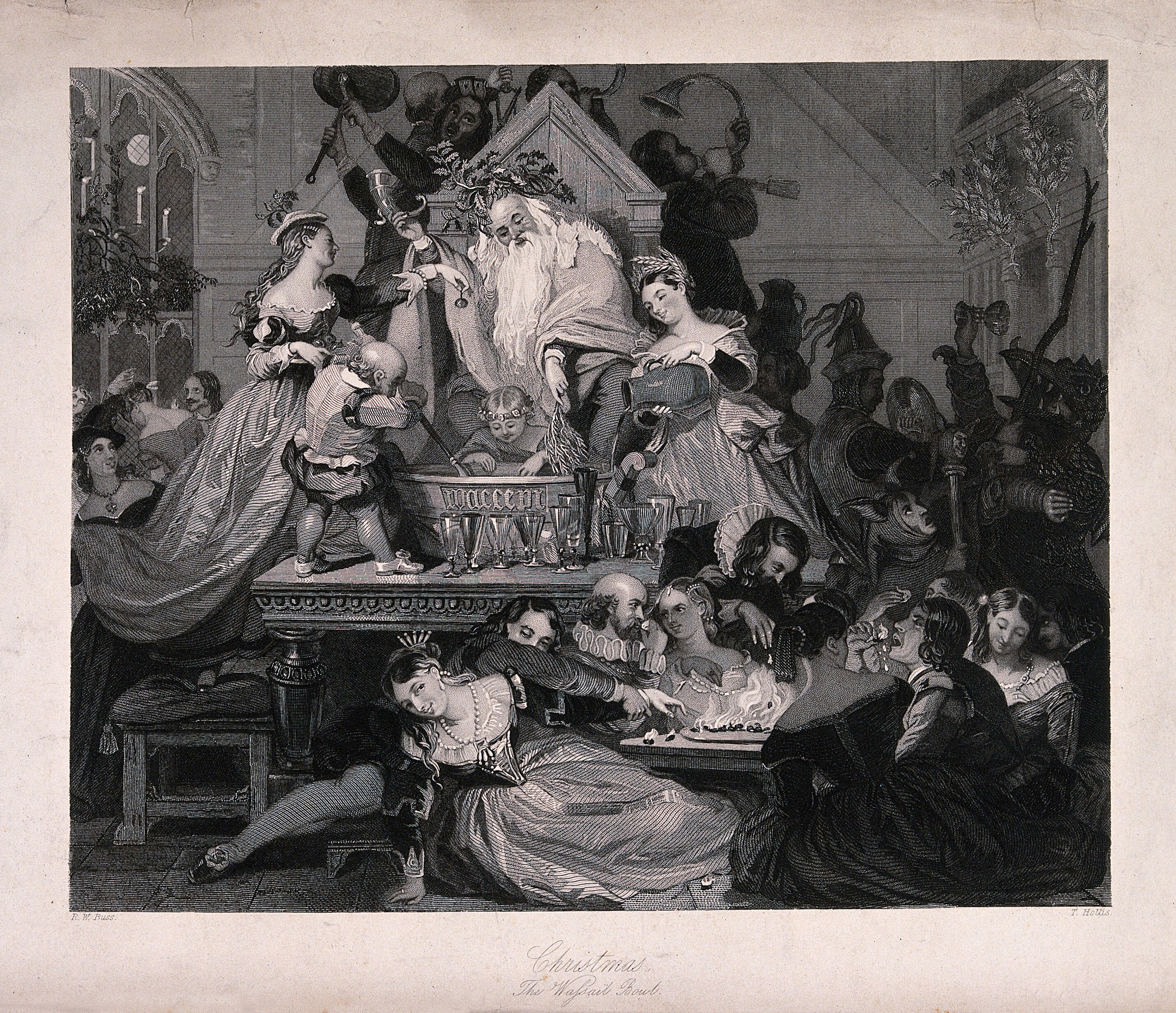
A later engraving of Father Christmas at the wassail bowl. 
By T. Hollis from the early 19th century.
Photographed by the Wellcome Collection.

We will continue looking at edible and quaffable elements in Robert Herrick’s holiday poems, leading into the fundamental moral and political ideal of hospitality. Returning to his “Twelfe night, or King and Queene,” we find that after the plum-filled cake is used to make known the king and queen for the evening, it is used to dip in, or is soused with, drink. Herrick writes:


“Which known, let us make

Joy-sops with the cake,”


“Joy-sops" is just a more poetic way of saying the poetic phrase “sops of joy.” What the cake is being sopped in is interesting. The ultimate goal is “To make the wassail a swinger;” what precedes this are, in other words, instructions to make a great drink.


But let us see those directions or a basic recipe again:

Next crown the bowl full

With gentle lambs-wool;

Add sugar, nutmeg and ginger,

With store of ale too.

And thus ye must do...


The initial royal flourish aside, the only thing a bit different is “lambs-wool.” This is not as strange as it seems; it is a drink, still known some places today, and a period synonym for wassail, in fact. There was a later seventeenth century book called The Academy of Armory, part of which functioned as a kind of dictionary for scienctific pursuits and what we would call today, the trades. 


In the section, “The Names of Several Dish-Meats and Cooks Terms Alphabetically,” between “Umble Pie, is a Pie made of the Intrals of a Deer, as Heart, Liver, &c.” and “Whipt Cream, it is beaten thick with a Whisk, then eaten with Cream and Sugar” is the definition of interest:

“Wassell, is a drink of Ale, toasted Apples, Sugar and Cinnamon mixt. Of some called Lambs-Wool.”

This even more basic recipe has a few minor differences but there are some shared, basic ingredients – sugar, apples and ale.

Why was it called lambswool? (What wassail means we will get to later as well). Some writers think that the fuzzy head on it reminded the drinkers of the small animal’s covering. General Charles Vallancey, a British army surveyor sent to Ireland disagreed. He stayed in Ireland after his service and became a writer on Irish history and customs. In Volume III of his Collectanea de Rebus Hibernicis [Collection of Irish Affairs], published in 1786, he says:


“The first day of November was dedicated to the angel presiding over fruits, seeds, & c. and was therefore named LA MAS UBHAL, that is, the day of the apple fruit, and being pronounced LAMASOOL, the English have corrupted the name to LAMBSWOOL, a name they give to a composition made on this eve, of roasted apples, sugar and ale.”

So, we know from many sources how to make a swinging wassail. Interesting that Robert Herrick was using “swinging” as a positive adjective well before the 60s or even Jazz Age.

The poet recounts the use of this drink in celebration elsewhere in his collection Hesperides. In verses talking about the good old days with a friend, he says they should relive various celebratory times. One instance being:


Then next I’ll cause my hopeful Lad

(If a wild Apple can be had)

To crown the Hearth,

(Lar thus conspiring with our mirth)

Then to infuse

Our browner Ale into the cruse:

Which sweetly spiced, we'll first carouse

Unto the Genius of the house.


A “lar” is a Roman household god or spirit; in the English context it was a fairy-like being which was often a guardian of the hearth and therefore good conspirators in this context. Once the lambswool or wassail is put together, essentially what is a toast is made to the lar: the speaker and his guests “first carouse / Unto the Genius of the house.” When it first came into English from Latin, “genius” meant an attendant household spirit. 

That act also points to another word meaning: any “wassail” is a toast in and of itself. The Middle English predecessor to the word was the phrase wæs hæil - “be in good health.” This in turn came from the Old Norse ves heill with a similar meaning. The proper response to wæs hæil, if you are wondering, is drinkhail - “drink good health.” Important to remember.

While there are still many cocktail recipes online for lambswool, I will be trying a basic kid-friendly one over the next couple days and will report back. Also, tomorrow will be more about Herrick, both food and our more serious obligations for holiday hospitality.


Wednesday, December 22, 2021

More on Baby Cakes, later called Twelfth Night Cakes (this time with Beans and Peas)


Robert Herrick from the frontispiece of Hesperides 

Today’s focus is the food in the festive poetry of Robert Herrick, who was, as mentioned yesterday, a follower of Ben Jonson and supporter in writ of Royalist hospitality in the seventeenth century. He went to Cambridge, took orders and was a Church of England vicar for much of his adult life. This position was taken from him by the Puritan-leaning Parliament in 1647, after Royal defeats early in the English Civil War. It was restored to him again by Charles II in 1662. Looking for income in the intervening years he published his poetry under the title Hesperides, or, The Works Both Humane & Divine of Robert Herrick, Esq. in 1648. 

The first bit of Herrick’s holiday food we will look at is one found in the Jonson Masque; it requires a slight correction and further explanation. A Baby Cake was one name for little pastry figures representing the Christ Child. However, with further research, the Baby Cake mentioned by the earlier writer was actually more like the King Cake I compared to those. 

The character Babie Cacke in the royalty-presented Christmas, His Masque is accompanied by an usher who bears a great cake. One detail I failed to go into was the fact the cake came with “a beane and a pease.” This is what it most sounds like, the cake had a bean and a pea (both probably of the harder varieties) within it. 

We can use Herrick to explain what Jonson is referring to. Here is a poem from Hesperides, entitled “Twelfe night, or King and Queene:” 

Now, now the mirth comes 

With the cake full of plums, 

Where Beane's the King of the sport here; 

Beside we must know, 

The Pea also 

Must reveal, as Queene, in the Court here. 


Begin then to choose, 

(This night as ye use) 

Who shall for the present delight here, 

Be a King by the lot, 

And who shall not 

Be Twelfth-day Queene for the night here. 


Which known, let us make 

Joy-sops with the cake; 

And let not a man then be seen here, 

Who unurged will not drink 

To the base from the brink 

A health to the King and the Queene here. 


Next crown the bowl full 

With gentle lambs-wool; 

Adde sugar, nutmeg and ginger, 

With store of ale too; 

And thus ye must doe 

To make the wassail a swinger. 


Give then to the King 

And Queene wassailing; 

And though with ale ye be whet here; 

Yet part ye from hence, 

As free from offence, 

As when ye innocent met here. 

The occasion is the Twelfth Night or Epiphany Eve (5 January) and there is a cake full of plums (probably actually raisins – more on that soon). The bean and a pea hold special places, they will reveal the King and Queen. It is like the still-current practice of King Cake, where a figure of a baby is baked into the cake and whoever gets the piece that holds it is declared king. In this case, the piece with the bean would “cho[o]se” who would “Be a King by the lot,” ie. lottery, while the piece with the pea “must reveal” the queen. I find an interesting parallel with the Princess and the Pea from Hans Christian Andersen but since that comes from a Scandanavian tradition, the connection would need be very far back, maybe before the English split from those peoples.  

In another of his poems, A New Years Gift, Herrick speaks again of this celebratory quasi-ceremony. His gift is a verse that will speak of the joys the season just passed, he writes: 

Of twelfth-tide cakes, of pease and beans, 

Wherewith ye make those merry scenes, 

Whenas ye chuse your king and queen, 

And cry out, Hey for our town green! 

This tradition was, even then, an old and wide spread one. The later seventeenth century writer Aphra Behn, in her short story, “The Court of the King of Bantam” has characters gather on “the Evening o' Twelfth-day, to renew the famous and ancient Solemnity of Chusing King and Queen.” A passage detailing the night reads: “After Supper...then the mighty Cake, Teeming with the Fate of this Extraordinary Personage was brought in, which was then Cut and Consulted, and the Royal Bean and Pea fell to those to whom Sir Philip had design'd 'em.” Finding a bean in a cake was apparently part of an old saying then; one translator of John Calvin has him say in 1587, “they thought themselves to have found wisdom, like as we commonly say in the Proverb, that a man thinks he hath found the Bean in the Cake.” Calvin was French and the porcelain or now plastic baby in King Cake, or Galette des Rois, in the older French tradition, was once a fava bean. 

A British political carton by Isaac Cruikshank from 1797, showing a later version of a Baby Cake called a Twelfth Night Cake. 

There was more than just cake in Herrick’s “Twelfe Night”, including drinkable Lamb’s Wool, and culinary hospitality makes a number of appearances in his other works. More on those markers of Christmas cheer tomorrow.


Tuesday, December 21, 2021

Minced Pie and Baby Cake but Foh! to Fish and Fasts: Christmas Presented to the King in 1616.

Today we will have a slightly more modest portion of hospitality from the seventeenth century, covering a bit of what Robert May pined for, before the period of “unhappy and cruel Disturbances” that was the English Civil War. The focus will be the food.

We can turn to a relatively well-known poet/dramatist to see Christmas food in the first half of the seventeenth century. Ben Jonson was second only to Shakespeare in his influence on the stage during the reign of James I at the beginning of 1600s. He wrote a masque simply called Christmas, His Show or Christmas, His Masque. This form of drama is a kind of Early Modern musical – there was a story enacted, but also music and dance with often expensive and elaborate sets. Usually, they were performed in a noble house and included praise and/or a message for the wealthy host.

Jonson’s holiday extravaganza was presented at the royal court in 1616. Some of the festive food elements in Christmas, His Masque are actually characters. The play begins with Christmas personified bursting onto stage; he is soon followed by an entourage of his children. One is our old friend MINC'D-PIE, who appears “like a fine Cook’s Wife, dressed neat; her man carrying a pie, dish, and spoons.”

Christmas’s other child of culinary interest is BABIE-CACKE “dressed like a Boy, in a fine long coat, biggin [a cap like a nightcap], bib, muckender [handkerchief], and a little dagger; his usher bearing a great Cake.”

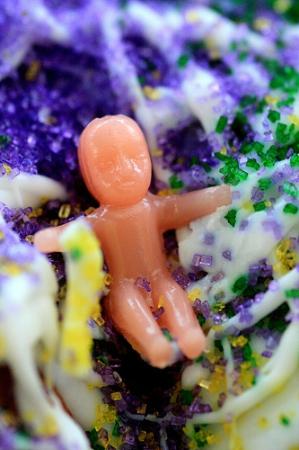
A Baby Cake is a holiday food that has been lost amongst the English world’s traditions but it is probably related to the porcelain or now plastic baby figures that are still found in celebration King (or Three King) Cakes, like those eaten at festivities in New Orleans. The King Cake is, and the Baby Cake was, served up especially at the Epiphany, twelve days after Christmas, celebrating Christ’s revelation to the three magi or kings. The baby, of course, represents the Christ Child and it was once popular for bakers to give such a small image made of pastry to each of their customers at Christmas. John Brand, a writer on "popular antiquities" or folklore in the eighteenth century says they were also called Yule Dough or Dow or Yule Cakes in the north of England. Writing even in 1777, he believed the practice “is now, if I mistake not, pretty generally laid aside, or at most retained only by children.”

A modern plastic baby in a King Cake.

In Jonson’s Masque, the two personified Christmas treats take part with the other children of Christmas in singing a welcome to the King and Queen, a future king and other nobles: 

“Now God preserve, as you well doe deserve, 

your Majesties all, two there; 

Your Highnesse small, with my good Lords all, 

and Ladies, how doe you do there? 

Gi'me leave to aske, for I bring you a Masque 

from little little little little London; 

Which say the KING likes, I ha'passed the Pikes, 

if not, old Christmas is undone.” 

The welcome ends with a bit of vague warning about the holiday being undone, this is soon explained as having a Christmas food context. Christmas picks up on it and asks: “whats the matter there?” One of the other children - Gambol, who represented Christmas dancing or frolicking answered: “Here's one, o' Friday street would come in.” This is a reference to fish or fast Fridays and the child of Christmas is warning that the belief that the hol(y)days should be practiced as more somber, less food-filled occasions was starting to come into English society.


The Father sounds angry: “By no meanes, nor out of neither of the Fishstreets, admit not a man; they are not Christmas creatures: Fish, and fasting dayes, foh!” The Puritan ideals that conflicted with many Church of England traditions and came to a head in the English Civil War, were beginning to gain a significant following even when this masque was performed in 1616. Those views were especially prevalent in London, which the song of Christmas’ children mentions. Among the things in the Masque that were probably offensive to those of such faith was the Christ being an image - in the form of a cake - and that He was a child of and subject to Christmas, the festival.

In opposition to Puritan sentiments, Father Christmas sings of what his children will present to the King and his court: 

“Now their intent, is above to present

with all the appurtenances

A right Christmas, as of old it was,

to be gathered out of the Dances.”

Appurtenances are additional elements, in modern culinary speak he could have said “with all the trimmings.” Their presentation, their holidays included everything. This is the “right” Christmas, as it used to be. There are, of course many other elements to festive celebrations but as the representation of Minced Pie and Baby Cake as children of Father Christmas shows, lots of food was vital to the hospitality of the holiday.

A later representation of Christmas and His Children by Robert Seymour (1836). Baby and King Cake may be conflated and seen in back left with a possible Minced Pie beside him. An interesting addition is the central Sir Loin. 

Tomorrow we will look at the Christmas poetry of Robert Herrick.  He was one of the Sons of Ben, followers of Jonson who supported James’s son Charles I with their writings.  

Monday, December 20, 2021

Hospitality Revived: Lots of Christmas Food and Scrooge's Spiritual Ancestors Condemned

The woodcut above shows a man obviously enjoying himself: he has all the food (maybe some pies in the upper left) and drink he needs and has settled in for a good night. It comes from the printing of a broadside ballad called Old Christmass Returnd, Or, Hospitality REVIVED.* The last line of that song's chorus is merely a belted-out list of holiday food: “Plumb pudding, Goose, Capon, minc't pies & Roast beef.” You can hear how it was probably sung here

However, the second half of the title alludes to something more serious and certainly a fair bit darker. The subtitle of the piece begins: “Being a Looking-glass for rich Misers, wherein they may see (if they be not blind) how much they are to blame for their penurious [stingy] house-keeping." Hospitality is warmly celebrated but its inverse is coldly condemned. The final verse of the ballad makes this point, clearly and more brutally:

Then let all Curmudgeons who dote on their wealth

And value their treasure much more than their health

Go hang themselves up, if they will be so kind,

Old Christmas with them but small welcome shall find

They will not afford to themselves, without grief

Plumb pudding, Goose, Capon, Minc't pies & Roast beef.

It reminded me of the darker elements of a Christmas Carol, how many spoke of Scrooge after he was gone in Christmas Future’s vision. I will return to the hospitality in the food of the above song tomorrow but today I would like to focus on the concept itself and why it provoked such strong feelings. It is hard to escape food entirely and we begin that exploration by looking back at a menu that includes many of the items named in Old Christmass Returnd, Or, Hospitality REVIVED.

Bills of fare, like the one covered in my entry last week, were not a rare thing to see in cookery books in the seventeenth century. These menus for a season, day or specific feast were included by most writers and publishers in the period. For instance, Hannah Woolley, in her Queen-Like Closet gives “A Bill of Fare for the Spring Season,” one for Midsomer and more specifically for “a Gentlemans House about Candlemas, as well as for a number of other “Extraordinary Occasions.” Her titles are basic, as are Robert May’s in his book, The Accomplisht Cook; except, as I noted last week, he adds a nostalgic politically-loaded rider. He does not present a menu for contemporary use but instead for “service, as it was used before hospitality left this Nation.”

This seasonal menu is not the only mention of “hospitality” found in the cook’s book. In fact, May or his publisher included the word in almost all of the introductory material that precede the actual recipes. The frontispiece, or the picture found opposite the title page, is a woodcut portrait of May. Below the representation of the author looking side-eyed at the reader is this (slightly modernised):


What? wouldst thou view but in one face

all hospitality, the race

of those that for the Gusto stand,

whose tables a whole Ark comand

of Natures plenty, wouldst thou see

this sight, peruse May’s book, 'tis he.

May is thus first introduced, representing all hospitality, all gusto or taste and one whose tables provides an ark’s-worth of nature’s plenty.

The title page is next and then a somewhat lengthy dedication. This was also common in the period: patronage of the wealthy could still be the primary source of income for authors and the dedication was usually addressed to them. Sometimes it was in acknowledgement of past support and sometimes it was an attempt to get a patron’s attention. May’s dedication heading reads: “To the Right Honourable my Lord Lumley, and my Lord Lovelace; and to the Right Worshipful Sir William Paston, Sir Kenelme Digby, and Sir Frederick Cornwallis; so well known to the Nation for their admired Hospitalities.” The cook is casting a pretty wide net and those named are important - who they are can be explored elsewhere - but to be short, again it is for hospitality they are lauded.

The historical context is partially explained in a line that follows, May says: “for my own part, my more particular years of service to you my Honoured Lords, have built me up to the height of this experience, for which this Book now at last dares appear to the world: those times which I attended upon your Honours were those golden dayes of Peace and Hospitality, when you enjoy'd your own, so as to entertain and relieve others.” The nobility addressed are not quite enjoying their own - they have suffered, at least somewhat, in the English Civil War and Cromwell’s rule that occurred in the two decades before. They were supporters of the executed King Charles. The word “hospitality” tended to identify those on the Royalist side of the bloody conflict.

The line of praise also explains part of what hospitality meant politically and practically in food and drink, especially at Christmas. In May’s remembrance, whether real or idealised, when the nobility were in their place, they entertained and relieved others. In the political ideal of hospitality being referenced, this entertainment and relief was not just for those of the ruling class. There was an order to the world, with the king at its head; peasants served the noble but the noble, especially at festive seasons took care of his peasants. (The seminal book on this ideal - often only ideal and not practical - relationship in the period is “Hospitality in Early Modern England” by Dr. Felicity Heal. It is from there I took my first real understanding of it.)

May hammers on this idea again: “Your country [ie. lands and people] hath reap't the plenty of your Humanity and charitable Bounties. Right Honourable, and Right Worshipful, Hospitality which was once a Relique of Gentry…hath lost her Title through the unhappy and cruel Disturbances of these Times."  He also mentions noble hospitality in what is essentially an address to the reader - “To the Master Cooks, and to such young Practitioners of the Art of Cookery, to whom this Book may be useful.”

Finally, the concept is critical in the biographical section of the preface; if May’s politics were not clear before, he plants a flag with a statement that actually provided the name for this blog. The cook formerly worked in noble houses and according to him, “then were those golden days wherein were practised the Triumphs and Trophies of Cookery, then was Hospitality esteemed, Neighbourhood preserved, the Poor cherished, and God honoured; then was Religion less talk't on and more practised, then was Atheism and Schism less in fashion; and then did men strive to be good rather than to seem so.” This is a scathing condemnation of Parliament and Cromwell’s upsetting of a natural order and he makes hospitality, like that which should be practiced at Christmas, fundamental to the things most highly valued in the period.

More tomorrow on how this, and specifically Christmas, hospitality was seen before, during and after the period England was without a royal head - the seventeenth century Interregnum.

*Once again this ballad has been preserved electronically by the English Broadside Ballad Archive.  The link for that entry is here.

Friday, December 17, 2021

Larks, Powdered Geese and a Kid with Pudding in his Belly; that and much more in Robert May's Christmas Feast.

Though from the continent not England, this scene of Christmas season celebrations was painted by David Teniers the Younger in the mid-17th century, the period of focus for today's writing on seasonal feast.

The holiday season being what it is, I will not be able to get into a deeper discussion of hospitality today, as I am a little busy helping someone enact the idea in real life.  

I will, however, provide a bill of fare or, in other words, a menu for Christmas Day and explain a few of the interesting items, to me at least. Whether the massive amount of meat was from an actual feast or whether it was a bit of propaganda, (more on that in the coming days) it was published in 1660 by Robert May in his The Accomplisht Cook, or The Art and Mystery of Cookery

The general heading for this section of his book is “Bills of FARE for every Season in the Year...as it was used before Hospitality left this Nation” ie: before King Charles I was killed and Parliament, then Cromwell, ruled England in the 1650s.  May is looking backing in nostalgia and probably forward, as the monarchy would be restored with Charles II, very soon after his book was published.  

But on to the food:  

“A Bill of Fare for Christmas Day, and how to set the Meat in order.

Oysters. 

1 A coller of Brawn. 

2 Stewed Broth of Mutton Marrow bones. 

3 A grand Sallet. 

4 A pottage of Caponets. 

5 A Breast of Veal in Stoffado. 

6 A boild Partridge. 

7 A Chine of Beef, or Surloin roste. 

8 Minced Pies. 

9 A Jegote of Mutton with Anchove sauce. 

10 A made dish of Sweetbread. 

11 A Swan roste. 

12 A Pasty of Venison. 

13 A Kid with a Pudding in his Belly. 

14 A Steak Pie. 

15 A hanch of Venison rosted. 

16 A Turkey roste and stuck with Cloves. 

17 A made dish of Chickens in Puff-paste. 

18 Two Brangeese rosted, one larded. 

19 Two large Capons one larded. 

20 A Custard. 


The second course for the same Mess.  

Oranges and Lemons. 

1 A young Lamb or Kid. 

2 Two couple of Rabits, two larded. 

3 A Pig soust with Tongues. 

4 Three Ducks, one larded. 

5 Three Pheasants, 1 larded. 

6 A Swan Pie. 

7 Three brace of Partridge, three larded. 

8 Made dish in puff-paste. 

9 Bolonia Sausage, and Anchove, Mushrooms, and Caviare, and pickled Oysters in a dish. 

10 Six Teels, three larded. 

11 A Gammon of Westfalia Bacon. 

12 Ten Plovers, five larded. 

13 A Quince Pie, or Warden Pie. 

14 Six Woodcocks, 3 larded. 

15 A standing Tart in puffpaste, preserved fruits, Pippins, &c. 

16 A dish of Larks. 

17 Six dried Neats Tongues. 

18 Sturgeon. 

19 Powdered Geese. 

Jellyes."

A peek ahead shows us our required mince pies and other uses for neat’s (cow) tongue but starting from the beginning, here are a few select and hopefully interesting explanations.  

A collar of brawn came to be a saying in the eighteenth century but here it just means the meat around the neck and chest of a brawn – a period term for a boar.  Brawn has also come to mean headcheese in the UK because it was probably originally made with boar but this use predates that.  

A Sallet is a salad – probably something green.  The word came to English from late Latin via French – where it was herba salata or salted greens. 

Caponets are young gelded roosters that are raised for eating.  

“Veal in Stoffado” means stuffed veal.  

Chine of beef is a standing rib roast, a cut that includes the backbone. 

The best guess for Jegote is a leg of Mutton 

Bran- or brant geese are smaller breed of geese.  

Larded means similar to today, to add fat to lean meats, usually using some kind of pork. 

Soust is sauced.  

Bolonia sausage is mortadella, the better precursor to the bologna of your sandwich.  

Teel, now spelled teal is a kind of duck. 

The gammon or ham from Westphalia continues to be famous.  

Plovers are small wading birds.  

Pippins are desert apples as seen in some mince pie recipes.  

Powdered geese are salted and therefore preserved geese.  Similar in a way to corned beef: corned referred to the size of salt – corn or grain sized ie. rock salt - that was used in the preserving process.  These geese were salted using the powdered variety, presumably. It is a dish found in a number of other works of food writing in the period.  

You end your meal with jellies or the seventeenth century version of Jell-O. 


If something seems a bit off-putting, you were not starved for variety.  This was part of the Christmas hospitality, lauded and derided, that I will discuss in the coming days.


Some pictures I took of a copy of Robert May's book, showing the foldout illustrations of the forms for various dishes, including some that are including in his Christmas bill of fare.  


Thursday, December 16, 2021

Christmas Pies: Badges of Distinction or Abominations?

The woodcut above comes from a broadsheet ballad probably published around 1660 and called the Merry Boys of Christmas*.

The lines relevant to the topic of this entry are near the end of the song: 

These Holidays wel briskly drink, 

all mirth we will devise, 

No Treason we will speak or think, 

then bring us brave mincd Pies: 

Roast Beef and brave Plum-Porridge 

our Loyal hearts to chear, 

Then prithee make no more ado, 

but bring us Christmas Beer. 

Today I write a little last bit about the crucial role of brave mince pie(s) in sixteenth and seventeenth century holiday celebrations.  These pies, as well as roast beef, and plum porridge/pottage/pudding were synonymous with the season.   

There was a mock debate called “A witty dialogue between Roast-beef, Mince-pye, and Plumb-pottage, contending for superiority with the verdict of Strong-beer, their moderator there upon” which was published in 1668 with Mother SHIPTONS Christmas CARROLS.  In the ensuing text, the three holiday staples argue and food pun amongst themselves.  For instance, Mince-Pye responds to Plumb Pottage’s claim of supremacy by reason of ancient custom with this retort:  

“Pish, never tell me of your Reasons: your Reasons are not in Date, and therefore, stark nought, and as for Custome, I say 'tis more Customary to prefer Pye before Pottage, ergo your Custome is not worth a Cucumber.” 

In the end, Strong Beer passes judgement, giving Mince-Pye a limited seasonal victory: “And for you Mr. Mince-pye, for the time of Christmas also are to be the Senior in all mens mouths, but ever after to disappear and vanish.” 

In more serious works, the importance of pies at Christmas is maintained.  In 1719, Frenchman Maximilien Misson’s observations on English life were translated and published as M. Misson's Memoirs and Observations in his Travels Over England. In his section on Christmas, he states: “Every family against [in preparation for] Christmass makes a famous pye, which they call Chrtistmass pye : it is a great nostrum [probably in the sense of a cure-all], the composition of this pasty; it is a most learned mixture of neats-tongues, chicken, eggs, sugar, raisins, lemon and orange peel, various kinds of spicery etc.” Sound basically familiar? 


For many, the importance of the pie connected to religious aspects of Christmas, even more societally critical than they would be today.  John Selden, a prominent period scholar of English law, much praised by the poet John Milton, said this in hisTable-Talk under the heading “Christmass”: “Our Meats...have Relation to Church-works. The Coffin of our Christmass-Pies in shape long, is in Imitation of the Cratch [manger of the Christ child].” A later writer in the literary periodical The Gentleman's Magazine, and Historical Chronicle makes this observation: “and may not the pie, a compound of the choicest productions of the East, have in view the offerings made by the wise men, who came from afar to worship, bring spices, &c.?”  William Bickerstaff, a prominent curate, schoolmaster and writer in the late 1700s said: “The Christmas Pye is in its own nature a kind of consecrated cake, and a badge of distinction.”  

This importance to some, especially in religious contexts, also made it a target for others.  Another writer in the aforementioned Gentleman’s Magazine writes of the pie’s specific religious significance given: “the zealous opposition it meets with from the Quakers, who...inveigh against Christmas Pye as an invention of the scarlet whore of Babylon, an hodge-podge of superstition, popery, the devil, and all his works.” Writing of the beliefs of related groups, a chronicler from the eighteenth century says: "Under the censure of lewd Customs...Christmas-Pye, is made an abomination." Similarly, pies are used in an anti-Catholic poem, which connects them with the failed Gunpowder Plot. Even inside the Church of England, seventeenth century poet Samuel Sheppard wrote an epigram entitled “Christmasse Day” which rejects the culinary markers of the season:  

NO matter for Plomb-porridge, or Shrid-pies, 

Or a whole Oxe offered in Sacrifice 

TO COMƲS, not to CHRIST, this day I'le sing 

Coelestiall songs to IESƲS...

“Shrid” or shred is another term for mince and Comus was a demonic figure brought to prominence by Milton a few years earlier, who was based on the Greek god of festivals, revelry and illicit affairs. 

Much of the praise and condemnation of mince pies link to the period loaded word “hospitality” and its vital role at Christmas.  Tomorrow, we can look into that a bit more. 

---

*The English Broadside Ballad Archive provided an invaluable resource for such popular culture artifacts.  Here is the link for that specific work https://ebba.english.ucsb.edu/ballad/30942/xml


Wednesday, December 15, 2021

Neat-Tongue Mince Pie Addendum II: Things Learned In and Around Pastry Failures

In searching for a period recipe to adapt for my neat-tongue mince pie, I had mentioned a couple days ago going through a few different works from the seventeenth and eighteenth century. One of the things I was looking for was what, if any, paste or pastry they specified, as I wanted to make that element historically authentic, if I could. 

The earliest was from the 1678 Rare and Excellent Receipts. Experienc'd, and Taught by Mrs. Mary Tillinghast. She does give advice as to what meat is best but merely then says “fill your Pie.” The Whole Duty of a Woman from 1700 is similar: the pie itself is merely implied. There is no mention of paste and the last line is “So close it up and bake in a gentle oven.” 

The edition of The Accomplish'd Ladies Delight from 1689 offers a clue. It reads: “then being all well mixt together, put it into a Coffin, or many coffins, and so bake them.” As I mentioned, a coffin is a raised pastry case; these would often hold a whole animal in Early Modern banquets. 


Shakespeare, a few years before the recipes in question, uses word play and demonstrates that a coffin would connect with raised (or reared) pastry in a period audience’s mind. In the gory tragedy Titus Andronicus, the (anti)- hero takes revenge for his slain and abused children by killing the two sons of the woman responsible. He then makes a pie of them and feeds it to her. Before their demise, he says to the two men: 

Hark, villains, I will grind your bones to dust,

And with your blood and it I'll make a paste, 

And of the paste a coffin I will rear, 

And make two pasties of your shameful heads, 

And bid that strumpet, your unhallowed dam, 

Like to the earth swallow her own increase. 

The recipe calling for a coffin in making a mince pie would probably mean it was recommending hand-raised hot-water pastry. I have wanted to try this for a while. A number of years ago, The Great British Bake-off (or The Great British Baking Show) did a technical challenge where the contestants had to make Paul Hollywood’s Hand-Raised Chicken and Bacon Pie. The first link below shows video of the introduction to the challenge and the second link is Hollywood’s recipe with a demonstration of raised pastry at the bottom. 

https://www.pbs.org/video/hand-raised-pie-nqdlg9/  

https://www.bbc.co.uk/food/recipes/hand-raised_chicken_and_12433  

I hope to have some time to do another period Christmas recipe with this type of pastry in the coming days. But that all being said, I did not use it for my mince pie. 

The final recipe I looked at for a neat-tongue mince pie - the one I decided to follow fairly closely - was quite clear about what pastry to use and how to use it. Elizabeth Raffald’s The Experienced English House-keeper says to “make a rich puff paste” and she mentions putting things in a pot or pan. I did some research to see whether puff paste meant something similar as it does today and it did, so the pie is meant to be made with puff pastry in some kind of vessel, as opposed to being free-standing.

There was a wealth of puff pastry recipes in a book from 1696 called The Family-dictionary; Or, Household Companion by William Salmon, Professor of Physic. 


From the four above you can see, there is a rich dough to which more butter is added, often in stages, and then rolled multiple times.  Similar in that method was a recipe that I found in Raffald’s book. Wanting to maintain consistency with period instructions, I decided to go with that one, which she called "To make a cold Paste for dish Pies."

Once I had committed to this and got through the early, straight forward, parts of the recipe – flour, eggs, water - I realized that there was ambiguity. She tells you to rub a half pound of butter into the flour and then add, presumably, more butter in slices after you have rolled it out. She does not say how much more butter, but going from modern puff pastry recipes the ratio of flour to butter is relatively equivalent. This meant I was to add another half-pound of butter, which I attempted to do in three stages as per the recipe. I followed her instructions in that I rolled it up tight and rolled it out again a total of three times. 


However due to my ignorance of pastry, or the recipe itself, this did not create layers but made great streaks of just butter that made the pastry nearly impossible to work with. I cheated a bit by chilling the pastry in between each rolling, but this helped very little. I did manage to fashion a bottom and a top and get it in the oven. Now when I say that this was a failure, I add the caveat that it did taste really good. This is not surprising given how much butter was added. The failure came in the amount of liquid produced and the absence of any real pastry structure as you can see. Still, I made period puff pastry and have something delicious and certainly edible. 

Tomorrow I will do a little coda on the importance and sometimes infamy of mince pies before moving on to other things Christmas.